

From Stadiums to Studios: How Global Sporting Events Became Fashion's Fastest Innovation Labs
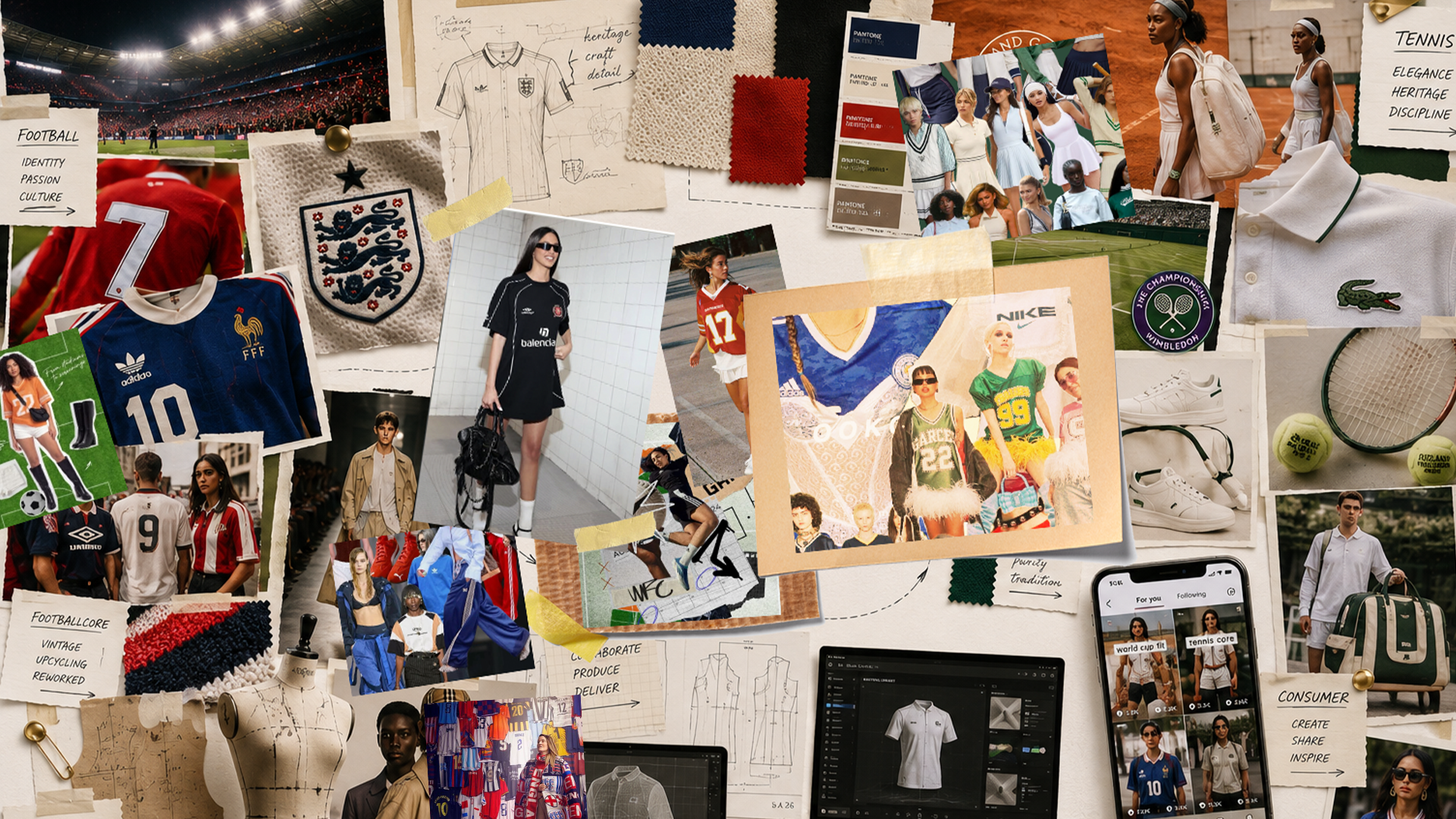
For decades, fashion looked to sport for inspiration. A championship win sparked a colour trend. A legendary athlete fronted a campaign. A jersey became a collector's item.
That relationship no longer describes what's actually happening.
Global sporting events have stopped functioning as inspiration and started functioning as infrastructure. They are now among the industry's fastest working innovation labs, where brands, designers and consumers test ideas in real time and in full public view.
From the FIFA World Cup to Roland Garros and Wimbledon, the world's biggest sporting stages are compressing trend cycles, rewriting the rules of collaboration and forcing brands to rethink how products get designed, developed and shipped.¹
That compression is the real story. When culture moves at tournament speed, product development either keeps pace or gets left behind.
The World Cup Stopped Being About Jerseys
Football shirts used to be simple: a loyalty marker, worn inside the stadium, replaced every season.
That model is over.
The FIFA World Cup has turned the jersey into one of fashion's most contested design surfaces. Official kits are no longer confined to match day. They're styled as streetwear, layered into luxury looks and cut apart entirely by a growing field of independent designers who treat the shirt as raw material rather than a finished product.²
Sportswear leaders like Nike, adidas and Puma continue to push performance apparel forward, but the cultural conversation has moved past the major brands. Kappa's "Beyond the Game" campaign is the clearest signal of where this is headed: rather than treating jerseys as fixed, sponsor-controlled artefacts, the brand handed its own archive to designers Tega Akinola and Kiqué Sanchez to deconstruct and rebuild.³ That's a brand admitting the jersey's most valuable life happens after it leaves the factory.
The same logic is playing out across an entire generation of jersey upcyclers. Designers like Mia Marquez, Hattie Crowther, Savannah Oh, Renata Brenha and Helen Hardy are reworking match kits into pieces built for bodies the original garments were never cut for, treating deconstruction as both a design language and a statement.⁴⁺⁵ Meanwhile, collaborations like Umbro x American Eagle show heritage football brands moving deliberately into mainstream fashion distribution, proving terrace culture now carries as much commercial weight on the high street as it does on the pitch.⁶
Treat the jersey as a finished product now and you're already working from an outdated brief. The smart money treats it as raw material.
Sport Is Fashion's Biggest Stage, Full Stop
The influence doesn't stop at the kit.
Global sporting events have become the moments where luxury houses, sportswear giants and independent designers compete for attention alongside the athletes themselves.
Burberry's "A Good Sport" campaign, fronted by Declan Rice, Leah Williamson, Eberechi Eze and Son Heung-min, didn't just borrow football's cultural cachet. It reframed match-day ritual through British heritage, shot by a Vogue-credentialed photographer and built around the ordinary texture of fandom rather than glossy spectacle.⁷ That's a deliberate positioning choice, not a sponsorship logo slapped on a tracksuit.
Athletes have moved past their old job description. They're not brand ambassadors anymore. They're collaborators, tastemakers and de facto creative directors whose influence starts well before kickoff and doesn't stop after the final whistle.
A tunnel walk. A post-match interview. A dressing-room post. Every one of these is now brand content, whether the brand asked for it or not.
The sporting event has quietly become the runway, and has been for a while now. Brands still treating it as merchandising are already behind.
Tennis Proves Constraints Sharpen Innovation, They Don't Kill It
Football rewards bold expression. Tennis proves the opposite instinct works just as well.
Roland Garros sits at the intersection of elite sport and Parisian style, where luxury brands, athlete campaigns and performance apparel are all expected to deliver technical rigour and visual polish at once.
Wimbledon is the harder test. Its all-white dress code remains one of the strictest constraints in professional sport, tightened repeatedly since it was introduced in 1963.⁸ And yet the constraint hasn't limited creativity. It has redirected it.
Naomi Osaka's ceremonial entrance look, a robe by Tokyo designer Hana Yagi built from vintage kimono and bridal fabric, engineered to come off in under a minute to reveal her competition kit, makes the point directly: the constraint didn't stop the story, it structured it.⁹ Adidas has used the same white-only limit to justify material innovation rather than abandon it, developing embossed, body-mapped fabric specifically because colour wasn't an option.¹⁰ Even Coco Gauff's tournament wardrobe, built through her New Balance x Miu Miu partnership, proves individuality on court has never required colour to register.¹¹
The lesson extends past tennis entirely.
Innovation isn't about removing constraints. Sometimes the sharpest ideas only exist because of them.
Whether brands are designing inside FIFA regulations or Wimbledon's century-old rulebook, the ones winning are finding new ways to express identity without breaking the frame.
Consumers Aren't Following Trends Anymore. They're Setting Them.
The biggest shift isn't happening in design studios. It's happening in the hands of the people buying the product.
Fans today don't just purchase official merchandise. They style jerseys as everyday fashion, chase down rare vintage kits, customise official releases, commission one-of-one pieces from independent creators and document every version of it across TikTok, Instagram and Pinterest.¹²
Social media has collapsed the distance between inspiration and influence to nearly nothing.
A standout kit can appear on the pitch in the afternoon, generate styling content by evening and start shaping purchasing behaviour before the next match kicks off.
Call this what it actually is: a live feedback loop, not a trend cycle. And it means consumers stopped being an audience the moment they became co-creators.
For brands, that changes what success even looks like. Sell-through rate isn't the finish line anymore. Products keep generating value through customisation, resale, creator content and community engagement long after the initial purchase, which means the product's commercial life barely begins at the point of sale.
The product doesn't end at purchase. That's where its cultural life starts.
Why Digital Product Development Is the Real Competitive Advantage
The speed at which trends now form around global sporting events has become structural, not incremental. That distinction matters more than it sounds.
A single collaboration, an unexpected athlete entrance, or one unplanned styling moment can generate millions of impressions within hours. Social platforms amplify it instantly, creators respond before the news cycle catches up, and consumers start demanding the product while the tournament is still live.
That's an enormous opportunity. It's also enormous pressure.
Traditional product development, built around seasonal cycles, simply cannot keep pace with cultural moments that move in days, sometimes hours.
The brands winning right now aren't just designing better product. They're spotting opportunities earlier, collaborating faster, and getting to market while the conversation is still happening, not after it's moved on.
That takes more than creative talent. It requires connected product data, streamlined cross-team collaboration, AI-assisted workflows, and a digital product development foundation that lets teams move from concept to production without losing speed or creative control.
At Six Atomic, this is the exact problem we help solve. When a brand's construction and pattern data is already enriched, a jersey deconstruction or archive-driven capsule doesn't start from a blank page: design teams can move from concept to on-brand, production-ready assets while the cultural moment is still live, not after it's already passed.
The product journey has a habit of picking up speed right around the point most brands stop paying attention to it: the moment it reaches the customer.
Consumers remix it. Creators reinvent it. Social platforms amplify it, on a loop, continuously.
The brands built to respond to that cycle, rather than chase it after the fact, are the ones that will define the next decade of fashion.
Sources
1- Vogue – World Cup Fashion Collaborations - https://www.vogue.com/article/world-cup-fashion-collaborations
2- nss sports – The Most Talented Female Fashion and Football Designers - https://www.nss-sports.com/en/lifestyle/42208/female-designers-football-fashion
3- SoccerBible – Kappa Goes Beyond the Game With Upcycling at Its Core - https://www.soccerbible.com/lifestyle/clothing/2026/04/kappa-goes-beyond-the-game-with-upcycling-at-its-core/
4- nss sports – The Most Talented Female Fashion and Football Designers https://www.nss-sports.com/en/lifestyle/42208/female-designers-football-fashion
5- Hypebae – How Recovered Reworks Vintage Soccer Jerseys Into One-of-a-Kind Fits - https://hypebae.com/2026/7/recovered-reworked-vintage-soccer-jerseys-mia-marquez-designer-info
6- SoccerBible – Umbro x American Eagle Fuses British Heritage With U.S. Swagger - https://www.soccerbible.com/lifestyle/clothing/2026/06/umbro-x-american-eagle-fuses-british-heritage-with-us-swagger/
7 - WWD – Burberry Takes Over New York's Corner Bistro Amid World Cup Frenzy https://wwd.com/fashion-news/fashion-scoops/burberry-new-york-corner-bistro-a-good-sport-takeover-1239014028/
8- Forbes – Wimbledon's "Almost Entirely In White" Rule and One Loophole - https://www.forbes.com/sites/timnewcomb/2026/07/03/wimbledons-almost-entirely-in-white-rule-and-one-loophole/
9- CNN – Have Tennis Outfits Always Been This Outrageous? Kind Of - https://edition.cnn.com/2026/07/02/style/style-tennis-fashion-controversy-history
10- Forbes – Wimbledon's "Almost Entirely In White" Rule and One Loophole https://www.forbes.com/sites/timnewcomb/2026/07/03/wimbledons-almost-entirely-in-white-rule-and-one-loophole/
11- Harper's Bazaar – Wimbledon's All-White Dress Code Is Getting a Fashion-Forward Refresh - https://www.harpersbazaar.in/fashion/story/wimbledons-all-white-dress-code-is-getting-a-fashion-forward-refresh-1416424-2026-06-30
12- Vogue – World Cup Fashion Collaborations - https://www.vogue.com/article/world-cup-fashion-collaborations