

One Garment, Three Lives: What Wellness Dressing Reveals About the Future of Garment Construction
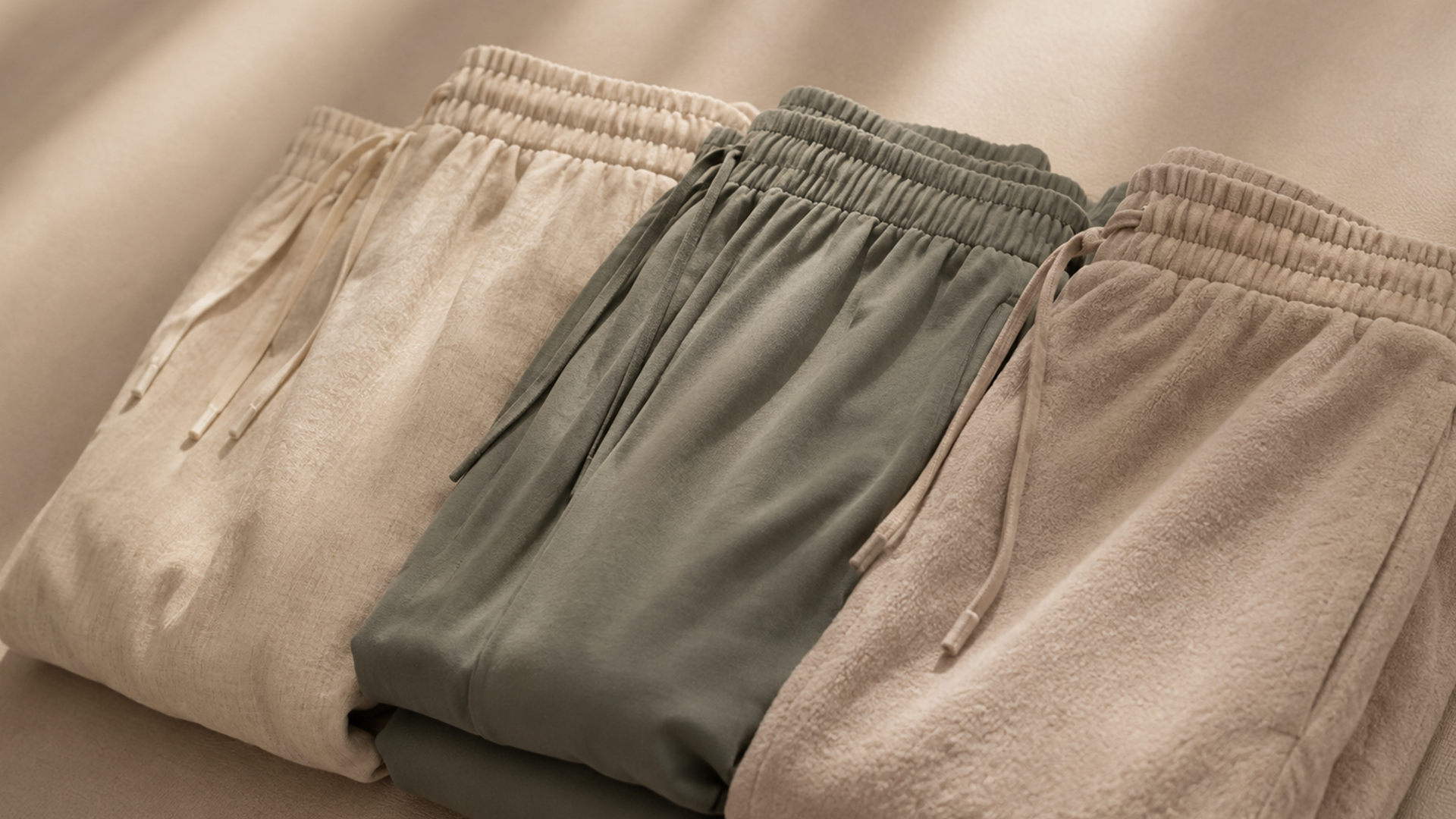
Wellness has quietly become one of the largest economic forces on the planet, now valued at $6.8 trillion globally and growing faster than world GDP.[1] Fashion has responded accordingly, embracing softer silhouettes, calming colour palettes and clothing designed for comfort. But the more interesting story isn't that wellness is influencing what we wear. It's that wellness dressing is exposing a construction challenge the industry has been quietly building toward for years: the expectation that a single garment should perform effortlessly across completely different moments of modern life.
Today's consumers increasingly expect one pair of trousers to travel, relax, work and socialise without looking out of place. They want wardrobes that pack lighter, adapt more easily and stay relevant across multiple occasions. Wellness may have accelerated this expectation, but it sits alongside broader shifts toward hybrid work, capsule wardrobes and more intentional consumption. The result is the same: one garment is now expected to live several lives.
Walk through almost any resort collection, activewear launch or travel edit today and one silhouette keeps reappearing: the relaxed wide-leg trouser, often styled as part of a matching set. Designers including Ferragamo, Kallmeyer and Victoria Beckham built their resort collections around this shape.[2] The same shift is playing out in activewear, where flared and wide-leg leggings are displacing the skin-tight cut as the studio-to-street default.[3] Meanwhile, designers such as Norma Kamali continue to champion elevated travel dressing, building brushed cotton terry separates meant to move comfortably from airports to restaurants to everyday life.[4]
The same silhouette now has three distinct jobs: a resort trouser, a lifestyle activewear pant, and a travel essential. To consumers, these products feel almost interchangeable. To product developers, they are anything but.
A pattern that performs beautifully in technical stretch jersey will not automatically translate to linen, brushed cotton terry or a lightweight blend. Each fabrication changes the way a garment drapes, stretches, recovers and moves. Ease allowances, grading, seam placement, waistband construction and finishing often need to be reworked even though the silhouette on the hanger appears almost identical.
The hidden challenge of consistency
Increasingly, brands are no longer designing separate products. They're building product families.
The same recognisable silhouette might appear as a lightweight linen version for summer, a technical knit for commuting, and a brushed cotton style for travel. Consumers expect each version to feel familiar, fit consistently and deliver the same experience regardless of fabrication.
That expectation creates one of the industry's most difficult technical challenges. Stretch, weight, recovery and shrinkage all influence how a garment fits and moves, and every fabric behaves differently. Maintaining a consistent fit across multiple fabric programmes requires repeated adjustments to grading, pattern engineering and construction details, even when the finished products look nearly identical. What appears to consumers as a simple extension of an existing style often represents several parallel development programmes behind the scenes.
When colour stops doing the differentiating
The challenge doesn't stop with construction. Colour direction has also converged toward warmth and restraint. Pantone named the earthy, grounded Mocha Mousse its Color of the Year, positioning it as a "trend-led fashion color and a neutral rolled into one."[5] The following year, Benjamin Moore named an espresso brown, Silhouette, its own Color of the Year, reinforcing the same warm, quiet neutral direction across an entirely different industry.[6] The same tonal palette is now showing up across resort, activewear and interiors alike.
As visual identities become quieter, colour and print lose much of their ability to distinguish products. What's left is construction: the way a waistband sits, the balance of a leg, the drape through the hip, the movement of the fabric while walking. In categories built around understated design, these details become the product.
The hidden complexity of looking effortless
Minimalism has always demanded precision, but wellness dressing raises the stakes further. Luxury brands are racing to capture the growth in wellness spending, and doing so tends to mean leaning into restraint and quality over logos.[7] Dior's decision to dedicate an entire floor of its New York flagship to a permanent spa, its first in the US, reflects the same instinct playing out at the experience level: the new frontier is a quieter, more considered form of quality that has to be felt rather than seen.[8]
The garments accompanying that lifestyle follow the same philosophy. Without loud prints, oversized logos or decorative hardware to distract the eye, every construction decision becomes visible. A sleeve that twists, a waistband that rolls or a seam that puckers immediately undermines the perception of quality. Looking simple is often the most technically demanding outcome.
What this means for product development
Put these forces together and the scale of the development challenge becomes clear. Brands are no longer creating isolated products. They're creating versatile garment platforms expected to perform across multiple fabrics, movement profiles and consumer occasions while maintaining consistent fit and appearance. At the same time, trend cycles continue to compress, leaving product teams less time to develop, test and refine multiple physical iterations.
Traditional sampling struggles to keep pace. Cutting physical toiles, fitting, revising and repeating that process separately for every fabrication quickly becomes expensive and time-consuming.
Digital product development offers a fundamentally different approach. By evaluating pattern behaviour across multiple fabric types before physical samples are produced, teams can assess grading, ease and fit much earlier in the development process. Pattern data, measurements, grading rules and construction information remain connected throughout development, allowing the same product family to evolve with greater consistency and significantly fewer physical iterations.
For brands navigating increasingly versatile collections, digital product development is becoming less about speed alone and more about managing growing product complexity without sacrificing quality. This is where Six Atomic's enriched pattern libraries earn their keep: because grading rules, construction details and a brand's own DNA are already connected to every pattern, a resort trouser, an activewear pant and a travel style built from the same block can be evaluated and adjusted across fabrications without rebuilding the pattern from scratch each time, keeping every version on-brand and production-ready.
Wellness dressing may look effortless. Building garments capable of living three different lives is anything but.
SOURCES:
Global Wellness Institute, 2025 Global Wellness Economy Monitor — globalwellnessinstitute.org/industry-research/2025-global-wellness-economy-monitor/
Fashionista, "8 Major Trends From the Resort 2026 Collections" — fashionista.com/2025/07/resort-cruise-2026-fashion-trends
Grazia, "New Year, New Activewear: The 2026 Athleisure Trends Taking Us From Street to Studio" — graziamagazine.com/us/articles/new-year-activewear-2026-trends-alo-nikeskims-splits59/
WWD/Sourcing Journal, "New Year Wellness & Fitness? Here's How Apparel Brands Can Help Consumers Reset" — wwd.com/sourcing-journal/lifestyle-monitor/new-year-wellness-fitness-apparel-brand-collections-cotton-1238931207/
Pantone, Color of the Year 2025: Mocha Mousse — pantone.com/color-of-the-year/2025
Benjamin Moore, Color of the Year 2026: Silhouette (AF-655)
Business of Fashion, "Opinion: Luxury Brands Need to Find Their Wellness Niches" — businessoffashion.com/articles/beauty/luxury-brands-wellness-opportunity/
CNN, "'Haute Couture' Facials and Re-Energizing Mattresses: Inside Dior's First Permanent Spa in the US" — cnn.com/2025/08/05/style/dior-luxury-spa-new-york-flagship