

The New Geography of Fashion: How Small Studios Are Changing What Comes Next
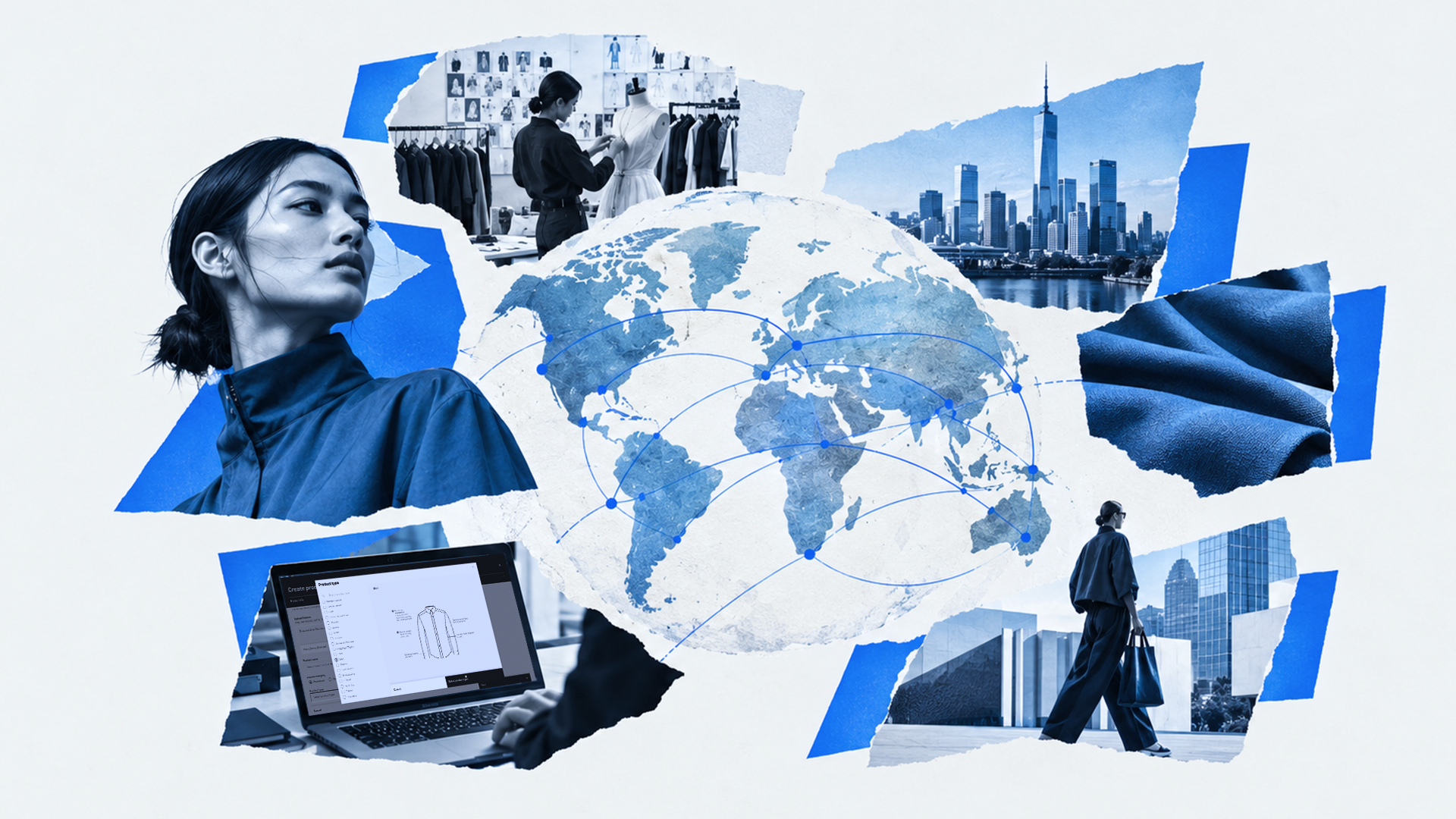
Fashion innovation used to have an address. Paris. Milan. London. New York. Those cities still hold the houses, the money, the media and the talent pipelines. They are no longer the only places the next idea comes from.
Some of the most interesting work in fashion is coming out of Seoul, Mumbai, Copenhagen, Lagos, Mexico City, Tbilisi, Bangkok and Jakarta. Small studios. Independent labels. Designers working outside the traditional system.
The map is getting bigger. The question is no longer where fashion happens. It is who has the tools to turn an idea into a product.
The creative economy has already moved
Global exports of creative services have passed $1.7 trillion, more than double the value of creative goods exports, and now account for a fifth of all trade in services [1]. Developing economies doubled their share of creative-services exports from 10% to 20% in just over a decade [2]. India, Singapore and China are among the fastest-rising exporters [1].
Creative work travels through networks now. It does not require proximity.
Fashion sits inside that shift. The BoF-McKinsey State of Fashion 2025 identifies Japan, Korea and India as the markets brands are pivoting toward as China slows, and names challenger brands as a growing source of profit and product innovation [3].
Creative influence is spreading across cities, communities and networks instead of concentrating in a few postcodes. That changes who gets to participate.
Small is a structural advantage
Small brands are not automatically more innovative. They have fewer resources, less financial cushion and fewer people to carry the work.
What size removes is friction.
A small studio decides quickly. Fewer approval layers. Fewer legacy assumptions. No existing product line to protect. A global company has the opposite problem: everything it makes has to work across markets, price points, channels and customer expectations at once.
The independent designer gets to ask a simpler question. What if we tried something else?
That question has commercial weight. In sportswear, challenger brands took three percentage points of market share from Nike and Adidas over five years by building hyper-targeted products and sharper cultural relevance [4].
Scale and creative influence are no longer the same thing. A studio of three can change a silhouette, a material or a community.
Independent labels are becoming laboratories
Independent labels run differently from traditional houses. Smaller runs. Limited drops. Made-to-order. Deadstock. Upcycling. Local manufacturing. Direct-to-consumer.
They can test an idea before building a seasonal infrastructure around it. Build an audience before building an organisation. Collaborate across disciplines that used to sit in separate parts of the industry.
Increasingly the experiment is the business model, not just the product. When tariffs squeezed American independents, fourteen New York labels pooled their clients into a single three-day pop-up where every designer kept 100% of their sales, with no retailer cut and no wholesale minimums. Jonathan Cohen, who organised it, put the shift plainly: "aside from being innovative in design, you have to be innovative in business" [5]. New systems, he argued, are now more interesting than new silhouettes.
The institutional ecosystem is catching up to that model. The European Commission's WORTH Partnership Project puts designers, manufacturers, makers and technology companies into the same development teams. Its second edition selected 202 transnational projects involving 465 partners across 34 countries, producing modular collections, upcycled footwear and energy-generating smart textiles [6].
Creativity, manufacturing and technology are no longer separate stages. The designer is in one city, the manufacturer in another, the technology partner somewhere else, and the customer anywhere. The network is the infrastructure.
There is still a problem.
The businesses with the most freedom to experiment have the fewest resources to execute. Turning an idea into a production-ready garment means pattern development, grading, measurement, sampling, fitting, prototyping, revisions and production communication. A large company absorbs that with specialist teams. For a small studio, every step is time, money and risk.
That is where technology stops being a convenience.
Technology changes who gets to experiment
The OECD treats digitalisation as the clearest route for small firms to raise productivity, innovate and compete with larger companies, while flagging the barriers that hold them back: limited resources, skills gaps and financing constraints [7].
Fashion is working out what that means in practice. When product-development technology absorbs repetitive work, improves communication and shortens iteration, four things follow.
A small team reaches capabilities that used to require a department. A designer refines an idea digitally before committing to physical development. A studio tests more ideas without increasing production risk. And a business outside the traditional capitals participates in global product development without rebuilding the infrastructure of a major house.
Technology gives creativity more room to move.
From capitals to networks
The future of fashion is not about replacing Paris, Milan, London or New York. It is about connecting them to a much larger network.
Paris stays a centre for luxury. Milan for manufacturing and design. London for creative culture. New York for media, retail and commercial fashion. Alongside them sits a growing network of small studios, independent designers, specialist manufacturers, technology companies and creative communities.
The creative economy is not a niche cultural conversation. It is a significant share of global trade [1].
The next advantage is iteration
For independent fashion, the opportunity is to become more capable without becoming bigger.
A small studio does not need to compete on collection size, store count or marketing spend. It competes on speed, specificity, experimentation and community. Increasingly it competes on how efficiently it turns an idea into a product.
That makes product development part of the creative equation, not a downstream function. When pattern, grading, measurement, 3D development and production workflows connect, designers get more chances to test and refine before committing resources.
The faster a studio moves from idea to experiment, the more ideas it explores. The more efficiently it moves from experiment to product, the less scale it needs to make those ideas viable.
A more distributed future
Fashion's next wave of innovation will not come from one new capital. It will come from hundreds of small studios across a much larger map. From designers working outside established systems. From manufacturers collaborating across borders. From labels building communities rather than distribution networks. From technology that lets smaller teams develop products with more precision, speed and flexibility.
The future may not belong to the biggest brands, the biggest budgets or the biggest cities. It may belong to the businesses that move from idea to experiment to product with the least friction.
When creative talent is distributed, the infrastructure supporting it has to be distributed too.
The next fashion capital might not be a city at all.
It might be a network.
Sources:
UN Trade and Development, Global exports of creative goods and services, UNCTADstat data insights. Creative services exports reached $1.7 trillion in 2024 against $709 billion in creative goods; creative services accounted for 20% of total services trade; India, Singapore and China named as significant developing-economy exporters. https://unctadstat.unctad.org/insights/theme/97
UN Trade and Development, Creative Economy Outlook 2024. Developing economies' share of global creative-services exports rose from 10% in 2010 to 20% in 2022. https://unctad.org/publication/creative-economy-outlook-2024
Business of Fashion and McKinsey & Company, The State of Fashion 2025. Pivot to Japan, Korea and India as China slows; sportswear growth led by challenger brands unburdened by historic assumptions about products, stores and customers. https://www.mckinsey.com/featured-insights/mckinsey-live/webinars/the-state-of-fashion-trends-that-matter-in-2025
McKinsey & Company, Sporting Goods 2025: The New Balancing Act. Nike and Adidas ceded three percentage points of market share to challenger brands between 2019 and 2024.
VOGUE: Madeleine Schulz, "Power in numbers: How independent designers are getting resourceful in a tough market", Vogue Business. The Collective, a three-day New York pop-up organised by Jonathan Cohen and Sarah Leff with 14 independent labels, each keeping 100% of sales. https://www.vogue.com/article/power-in-numbers-how-independent-designers-are-getting-resourceful-in-a-tough-market
European Commission, WORTH Partnership Project. WORTH II (2021 to 2025) selected 202 projects involving 465 partners across 34 EU-COSME countries. https://worth-partnership.ec.europa.eu/index_en
OECD, The Digital Transformation of SMEs. Digitalisation as a route to SME productivity, innovation and competitiveness, alongside resource, skills and financing barriers.