

Can AI replace 3D in fashion?
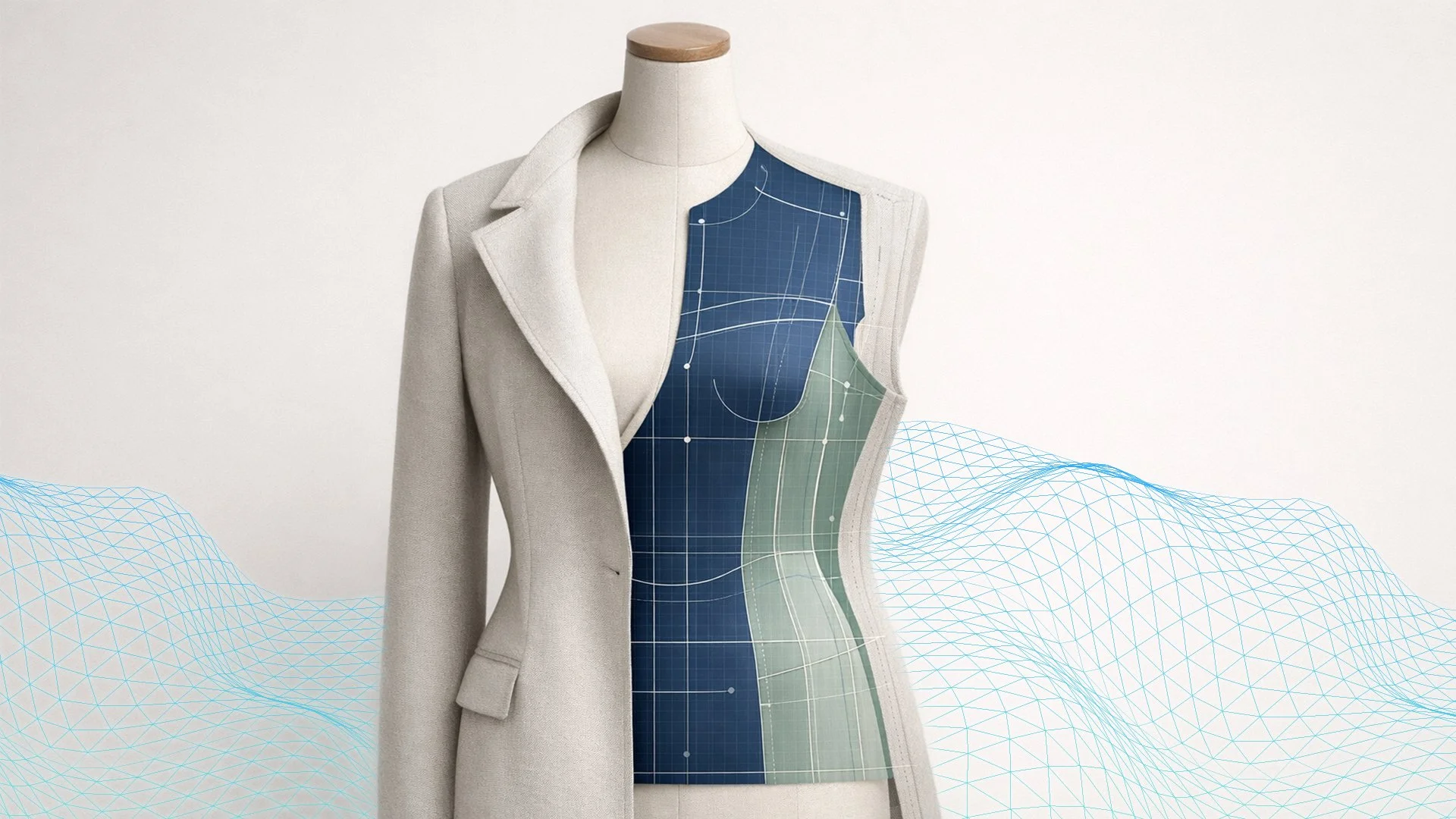
3D entered the fashion world long before it became the industry standard it is today. Its origins trace back to late twentieth century research, when engineers and designers began experimenting with virtual mannequins to simulate garment drape and fit on a computer. These early tools were limited in realism and difficult to operate, but they opened the door to designing fashion before fabric was ever cut. As computer aided design evolved, so did fashion technology, eventually giving rise to dedicated 3D garment simulation tools capable of modelling patterns, adjusting fit and rendering the behaviour of real textiles.
Despite these breakthroughs, adoption was never smooth or universal. Even today, for every fashion professional who embraces 3D, there are several who remain frustrated by it. The reasons are consistent across teams and companies. Most 3D software still has a steep learning curve compared to the tools patternmakers and designers are already fluent in. Not everyone knows how to use it, and when last minute changes are required, workflows can stall if the few specialists who manage 3D files are unavailable. In fast moving fashion cycles, this friction can feel risky rather than empowering.
This does not mean 3D failed. On the contrary, improvements in physics simulation, rendering quality and fabric libraries have proven its value. 3D reduces physical sampling, improves fit iterations and shortens development timelines when the right expertise is in place. The shift toward wider adoption became especially visible in the 2010s. Tommy Hilfiger, supported by PVH Corp, committed to building collections with 3D as early as 2019, investing in shared digital pattern and fabric libraries to accelerate development and reduce waste. Hanifa made headlines by presenting a full collection through a 3D digital fashion show, demonstrating that virtual garments could be expressive, desirable and commercially relevant.
At the same time, these examples also highlight a key limitation. 3D delivers precision, but it demands specialised skills and structured workflows. This is where AI changes the equation. AI tools often launch as complex technologies, but over time companies build industry specific workflows that remove unnecessary settings, technical tuning and process friction. The result is a much simpler experience for the end user. Instead of mastering an entire software ecosystem, designers and product teams can focus on decisions, not tools.
AI image generation is already proving its strength at the ideation stage. It can generate silhouettes, textures and concepts in minutes, dramatically accelerating early exploration. What it lacks in technical accuracy is exactly what 3D excels at. The opportunity is not replacement, but redistribution of effort. AI absorbs the complexity of early experimentation, while 3D is used where it matters most, validating fit, construction and production readiness.
This collaborative pipeline is already emerging. Research initiatives such as Dress 1 to 3 show how AI can help convert visual concepts into 3D ready assets. Platforms like CLO Virtual Fashion are building partnerships with companies such as Six Atomic to connect creative inputs with technical execution. These integrations reduce dependency on a small group of 3D experts and make advanced workflows accessible to wider teams.
For brands, this means a more agile and sustainable process, with faster decisions and fewer bottlenecks. For designers, it expands creative freedom without forcing everyone to become a technical 3D specialist. For product teams, it reduces dependency on a small group of experts and makes last minute changes manageable instead of disruptive.
This is exactly where Six Atomic delivers tangible value. Rather than asking teams to adapt to complex tools, Six Atomic builds the connective tissue between AI driven ideation, existing PLM systems and production ready workflows. The goal is not to replace 3D, but to make it usable at the right moments, by the right people, with far less friction. Just as 3D evolved from an experimental technology into a standard part of fashion production, the combination of AI and 3D, orchestrated through simplified, industry specific workflows, is becoming the new normal. It is not a competition, but a pragmatic partnership that strengthens both creativity and precision while keeping fashion teams moving at real world speed.
Sources
Tommy Hilfiger 3D workflow: Vogue, “Tommy Hilfiger and PVH Corp invest in 3D design” Hanifa 3D runway: FashionUnited, “The first 3D digital fashion show by Hanifa” Historical development of 3D fashion: SpringerOpen, “Recent developments in 3D garment simulation” Early virtual garment simulation research: core.ac.uk, “3D virtual garment simulation and CAD development” Adoption challenges and designer perspectives: Reddit threads on 3D garment design and CLO3D usage